Common Pitfalls in Using Metrics
“Dilbert Gets Rich” Comic
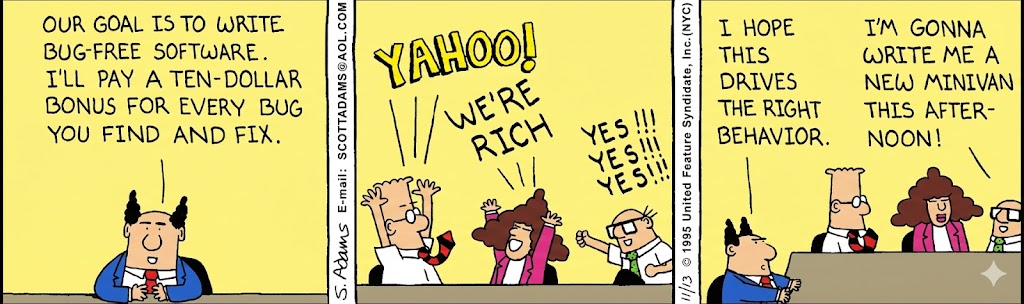
This comic humorously illustrates how metrics, when misunderstood or misapplied, can lead to absurd outcomes.
Key Issues:
- Bad Statistics
- Misunderstanding of measurement theory or what is actually being measured.
- Examples: Using averages without considering distribution, or treating ordinal data as interval data.
- Bad Decisions
- Misinterpreting data, leading to decisions with unintended consequences.
- Example: Releasing a product based on incomplete metrics without accounting for critical quality gaps.
- Bad Incentives
- Ignoring human factors and cultural dynamics in the organization.
- Example: Employees gaming metrics to meet targets rather than improving actual outcomes.
The Dangers of Using Software Metrics to (Mis)Manage
Metrics can have unintended consequences when misused in organizational management.
- Behavioral Changes: People often modify their behavior to meet metrics rather than to achieve real objectives.
- Unintended Side Effects: Misguided focus on metrics may overshadow the true goals of quality and productivity.
- Productivity and Quality Risks: Metrics misuse can lead to reduced productivity and lower quality, negating the original intent of the metrics.
Example from the Field
“The Darker Side of Metrics,” Eighteenth Ann. Pacific Northwest Software Quality Conf., 2000. [1]
This research highlights how metrics, while well-intentioned, can lead to counterproductive outcomes:
- Metrics Compliance Over Goals: Teams focusing on meeting numerical targets instead of solving real problems.
- Cultural Resistance: Negative reactions to being monitored can result in mistrust and lower morale.
Takeaway: Organizations must consider the broader implications of metrics and design systems that encourage genuine improvement without harmful side effects.
Metrics Biases and Fallacies
Several biases and logical fallacies can lead to the misinterpretation or misuse of metrics. Understanding these is crucial to avoid pitfalls.
1. Streetlight Effect
Looking for answers only where it is easiest to measure, ignoring more relevant but harder-to-measure factors.
Example: Prioritizing easily quantifiable metrics like lines of code over less tangible but critical aspects like code maintainability or team morale.
2. McNamara Fallacy
Relying solely on quantifiable data while ignoring qualitative insights.
- Step 1: Measure what is easy to quantify.
- Step 2: Disregard what cannot be quantified.
- Step 3: Assume what cannot be measured is unimportant.
Example: Judging software quality solely by defect count while ignoring user experience feedback.
3. Wrong Correlations
Mistaking correlation for causation.
Example: Assuming that a higher number of commits directly leads to higher productivity without considering the nature of those commits.
*4. Confounding Variables
Ignoring external factors that influence metrics.
Example: A team’s productivity drops after introducing a new tool. The metric ignores the learning curve required for the new tool.
5. Misrepresentation
Presenting metrics in misleading ways.
Example: Using pie charts to compare metrics with vastly different scales, making differences appear smaller than they are.
Summary
To use metrics effectively, avoid common biases and consider the broader context in which metrics are applied. When metrics are carefully selected, properly applied, and paired with qualitative understanding, they can drive significant improvements. However, without careful thought, they can lead to poor decisions, counterproductive behaviors, and unintended consequences.
Discussion:
- How might the “streetlight effect” influence decision-making in software projects?
- Can you think of examples where metrics-driven incentives backfired in real-life scenarios?
- How can organizations strike a balance between measurable outcomes and intangible quality goals?
References
- D. Hoffman, “The darker side of metrics,” in Pacific Northwest Software Quality Conference, 2000, p. 2000.
Disclaimer: AI is used for text polishing and explaining. Authors have verified all facts and claims. In case of an error, feel free to file an issue.