Maintainability Case Studies
Theory matters, but empirical evidence from real systems provides the most compelling arguments for investing in maintainability. The cases below span open-source browsers, commercial operating systems, industrial simulations, and automated tooling — yet they converge on remarkably similar lessons.
Mozilla: Architecture as a Managerial Choice
Context
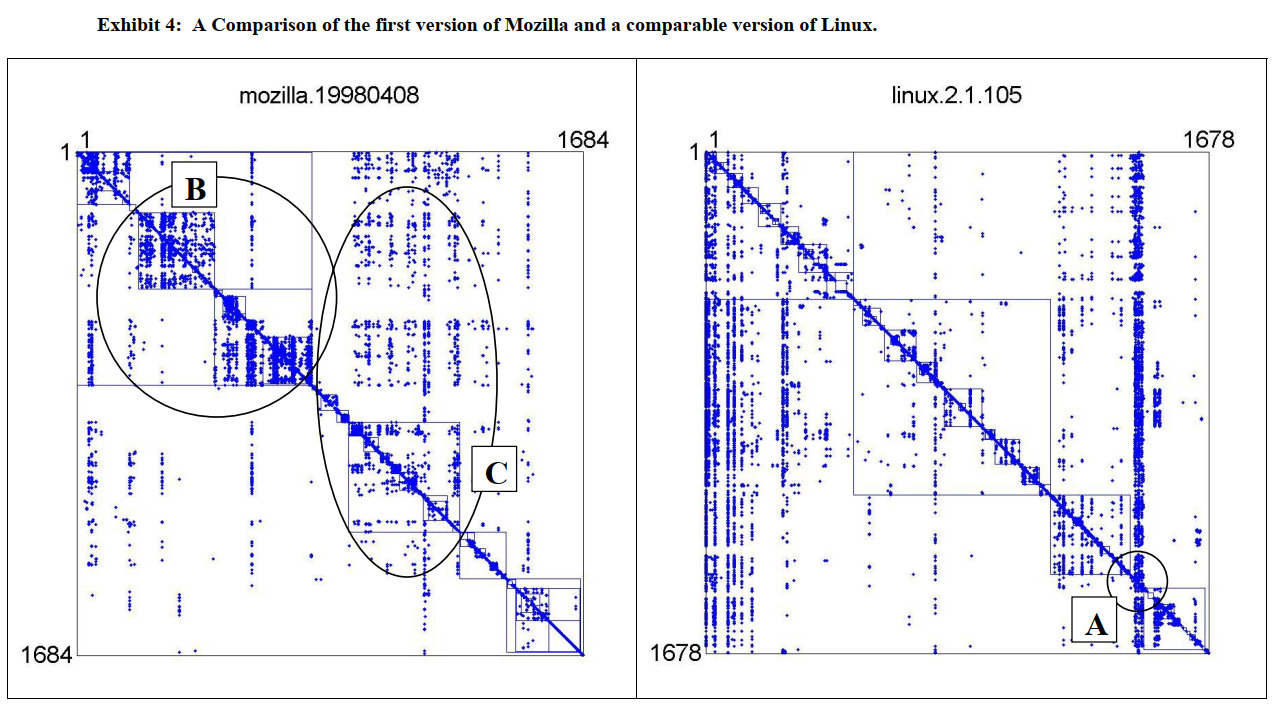
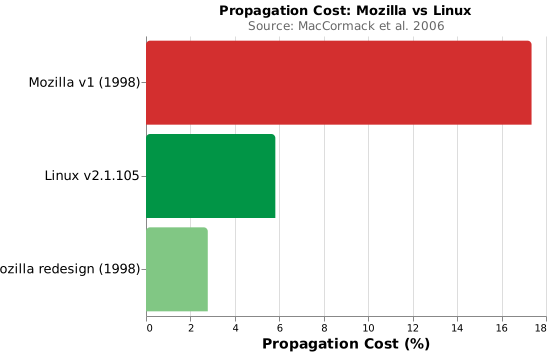
Mozilla (Netscape) released its proprietary browser code as open source in 1998. The initial code had a propagation cost of 17.35% — meaning a change to any file could potentially affect 17% of the entire codebase.
The Re-design
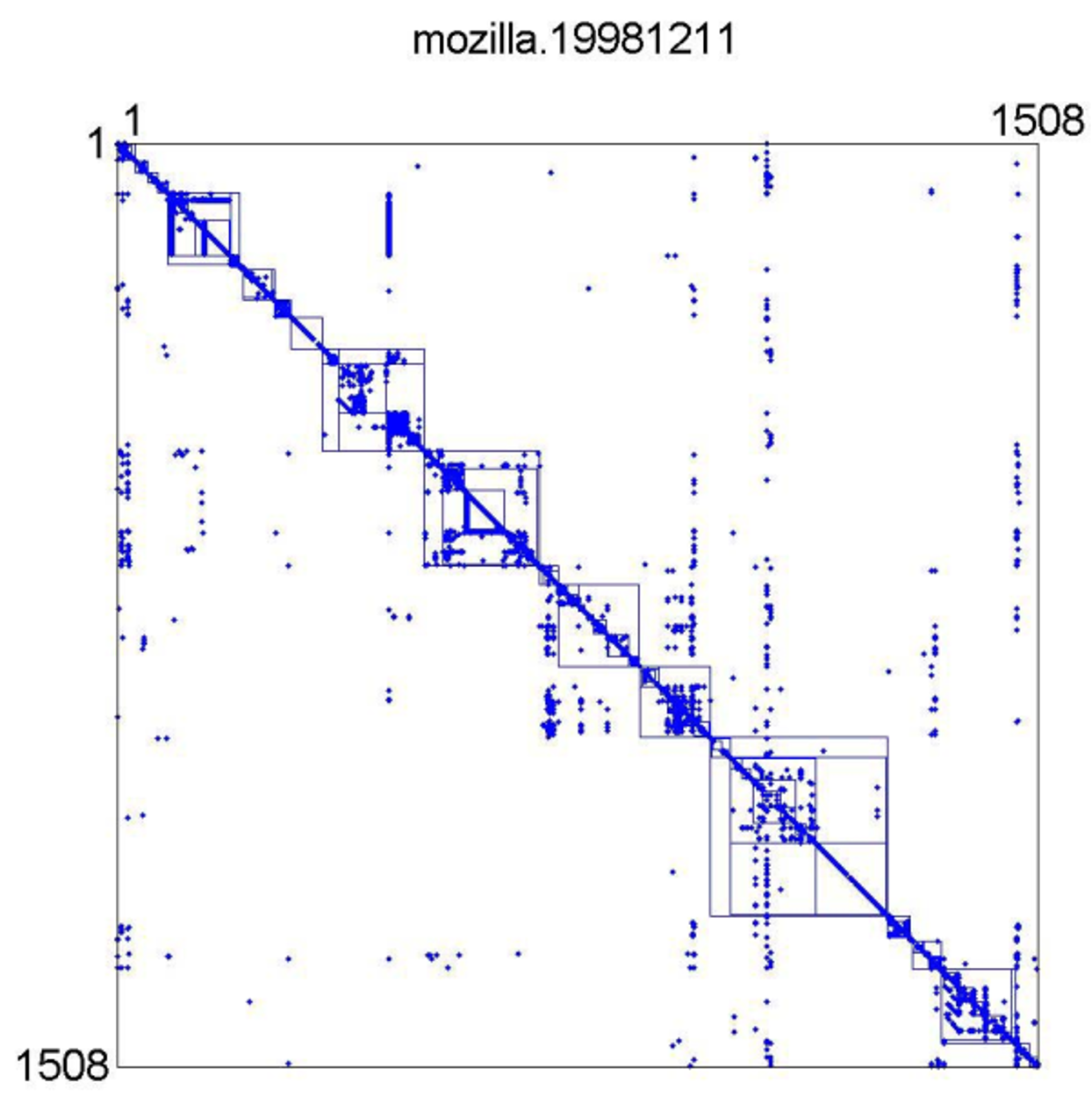
A purposeful architectural re-design in late 1998 restructured the codebase to reduce coupling and increase modularity.
Results
| Metric | Before | After | Change |
|---|---|---|---|
| Propagation Cost | 17.35% | 2.78% | -84% |
| Vertical buses | 2 | increased significantly | — |
| Architecture | highly coupled | more modular than Linux (5.82% PC) | — |
Lesson
Architecture is not determined by function — it results from purposeful choices by designers. An “architecture for participation” is essential for open-source success [1].
Microsoft Windows: Large-Scale Refactoring
Context
Kim et al. studied refactoring practices across 5 Microsoft products, including a multi-year effort on Windows [2].
Key Findings
| Finding | Detail |
|---|---|
| Top 5% of preferentially refactored modules | Inter-module dependencies decreased by factor 0.85 |
| Non-refactored modules | Dependencies increased by factor 1.10 |
| Engineer definition of refactoring | 78% defined it as any change improving readability/maintainability |
| Primary risk identified | 76% cited regression bugs |
| Effect on module size | Refactoring increased LOC even while reducing complexity |
Lesson
Measuring refactoring impact requires a multi-dimensional view — single metrics can give misleading results. A module may grow in size yet become easier to maintain.
ABB DID: Industrial Refactoring
Context
ABB’s DID physics simulation (30 kLOC Java) was considered “unmaintainable.” Adding a single new component required 59 changes across 17 classes, relying on error-prone copy/paste [3].
The Refactoring
Software engineering experts consulted with developers approximately 3 hours per week for 3 months. The focus areas were: separation of concerns (MVC), a fine-grained data model, and multi-level testing.
Results
| Metric | Before | After | Change |
|---|---|---|---|
| Duplicated code | 5,647 lines | 338 lines | -94% |
| FindBugs defects (normalized) | baseline | reduced | -23% |
| Time per new component | 6–8 weeks | 1–2 weeks | -75% |
| Automated tests | 0 | 200+ (unit + integration + system) | — |
Lesson
Relatively small expert investment (3 h/week for 3 months) can transform an “unmaintainable” system. Start with separation of concerns and automated testing.
Automatic Refactoring at Scale
Context
Szoke et al. developed a refactoring framework and deployed it at 4 companies across approximately 3 million LOC, performing around 4,000 refactoring operations [4].
Results
| Finding | Detail |
|---|---|
| Refactorings that improved maintainability | 55% (ColumbusQM model) |
| Refactorings that showed decrease | Only 10% |
| Most effective targets | Reducing coding rule violations and coupling |
| Tool chain | SourceMeter + IDE plugins (Eclipse, NetBeans, IntelliJ) |
The “UnnecessaryConstructor” Paradox
Some refactorings that fix a specific issue can accidentally worsen another metric — expert interpretation of measurement tools is essential.
Lesson
Automation helps at scale, but not all refactorings are equal. Target specific anti-patterns rather than applying broad transformations.
OSS Evolution Patterns
Context
Molnar (2020) studied maintainability evolution in 3 open-source projects (FreeMind, jEdit, TuxGuitar) over multiple years [5].
Key Findings
- Most maintainability issues concentrated in a small subset of packages.
- In jEdit, 6 packages accounted for 80% of maintenance effort.
- MI and ARiSA metrics were significantly influenced by software size (confounding variable).
- SQALE was not affected by size — making it more robust for longitudinal analysis.
Cross-Case Patterns
| Case | Investment | Key Metric | Improvement |
|---|---|---|---|
| Mozilla | Architectural re-design | Propagation Cost | -84% |
| Microsoft | Targeted refactoring | Inter-module dependencies | -15% (top modules) |
| ABB | 3 h/week expert guidance | Time per component | -75% |
| Automatic | Framework at scale | Maintainability score | 55% improved |
Four common patterns emerge across all cases:
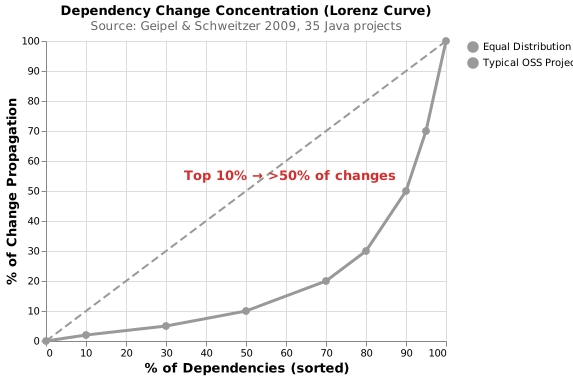
- Targeted intervention outperforms broad application. Mozilla re-designed architecture; ABB focused on separation of concerns; the automated framework was most effective against specific anti-patterns.
- Expert interpretation of metrics is essential. The “UnnecessaryConstructor” paradox and the Microsoft finding that LOC increases during refactoring both show that raw numbers mislead without context.
- Measurement must be multi-dimensional. No single metric captures maintainability. Propagation cost, duplication, defect counts, and development time each reveal a different facet.
- Small investments yield disproportionate returns. ABB’s 3 hours per week transformed a system; Mozilla’s one-time re-design cut coupling by 84%.
References
- A. MacCormack, J. Rusnak, and C. Y. Baldwin, “Exploring the Structure of Complex Software Designs: An Empirical Study of Open Source and Proprietary Code,” Management Science, vol. 52, no. 7, pp. 1015–1030, 2006, doi: 10.1287/mnsc.1060.0552.
- M. Kim, T. Zimmermann, and N. Nagappan, “An Empirical Study of Refactoring Challenges and Benefits at Microsoft,” in IEEE Transactions on Software Engineering, 2014, pp. 633–649. doi: 10.1109/TSE.2014.2318734.
- M. Wahler, U. Drofenik, and W. Snipes, “Improving Code Maintainability: A Case Study at a Large Scale Industrial Project,” in Proceedings of ICSME 2016, IEEE, 2016, pp. 493–497. doi: 10.1109/ICSME.2016.54.
- G. Szőke, G. Antal, C. Nagy, R. Ferenc, and T. Gyimóthy, “Do Automatic Refactorings Improve Maintainability? An Industrial Case Study,” Journal of Systems and Software, 2015, doi: 10.1016/j.jss.2015.03.012.
- A.-J. Molnar and S. Motogna, “A Study of Maintainability in Evolving Open-Source Software,” arXiv preprint arXiv:2008.04819, 2020.
Disclaimer: AI is used for text summarization, polishing and explaining. Authors have verified all facts and claims. In case of an error, feel free to file an issue.