| Guru | Contribution Summary |
|---|---|
| Walter Shewhart | Statistical Process Control, PDCA Cycle |
| Philipp Crosby | Quality as Conformance to Requirements, Prevention Focus |
| Joseph Juran | Quality as Fitness for Purpose, Pareto Principle, Juran’s Trilogy |
| William Deming | 14 Points for Management, Profound Knowledge System, PDCA Cycle |
| Noriaki Kano | Kano Model, Focus on Satisfiers, Delighters |
| Kaoru Ishikawa | Quality Circles, Fishbone Diagram, Seven Tools of Quality |
| Watts Humphrey | Software Quality, Capability Maturity Model, Team & Personal Software Processes |
Walter Shewhart (1891–1967)
Contributions:
- Control of Variation: Emphasis on identifying and controlling variation in manufacturing processes.
- Statistical Process Control: Differentiated between:
- Special Cause Variation (assignable)
- Common Cause Variation (random)
- PDCA Cycle (Plan, Do, Check, Act):
- Plan: Identify issues and plan solutions or activities.
- Do: Execute the plan.
- Check: Compare actual results with planned outcomes.
- Act: Adjust plans or improve performance based on findings.
Philipp Crosby (1926–2001)
Contributions:
- Quality is Free (1979):
- Quality is not about luxury but about conformance to requirements.
- Nonconformance is the absence of quality, leading to quality problems.
- Prevention over Correction:
- Focus on preventing problems rather than fixing them.
- Senior Management Commitment:
- Quality improvements require leadership involvement, not just delegation.
Joseph Juran (1904–2008)
Contributions:
- Quality as Fitness for Purpose:
- Meeting customer needs to ensure satisfaction.
- Balancing cost with quality improvement.
- Pareto Principle (80/20 Rule):
- Focus on the “vital few” problems that cause the majority of issues.
- Juran’s Trilogy:
- Quality Planning: Define objectives and processes.
- Quality Control: Monitor performance and address deviations.
- Quality Improvement: Continuously enhance processes and products.
William Deming (1900–1993)
Contributions:
- System of Profound Knowledge:
- Emphasis on systems thinking, understanding variation, and theory of knowledge.
- Deming’s 14 Points for Management:
- Focus on quality improvement through leadership, continuous learning, and teamwork.
- Popularization of the PDCA Cycle.
Deming’s 14 Points (Highlights):
- Create constancy of purpose towards product and service quality.
- Focus on quality over price in supplier relationships.
- Encourage teamwork and break down departmental barriers.
- Invest in lifelong training and education for employees.
Noriaki Kano (1940– )
Contributions:
- Kano Model of Customer Satisfaction: [1]
- Identifies how different features affect customer satisfaction.
- Categorizes product attributes into:
- Must-Haves: Basic needs. Lack of these causes dissatisfaction.
- Satisfiers: Features that increase satisfaction as they improve.
- Delighters: Unexpected features that excite and delight customers.
- Emphasis on Satisfiers:
- Satisfiers bridge the gap between basic needs and delight. These features require incremental investment but directly enhance customer satisfaction.
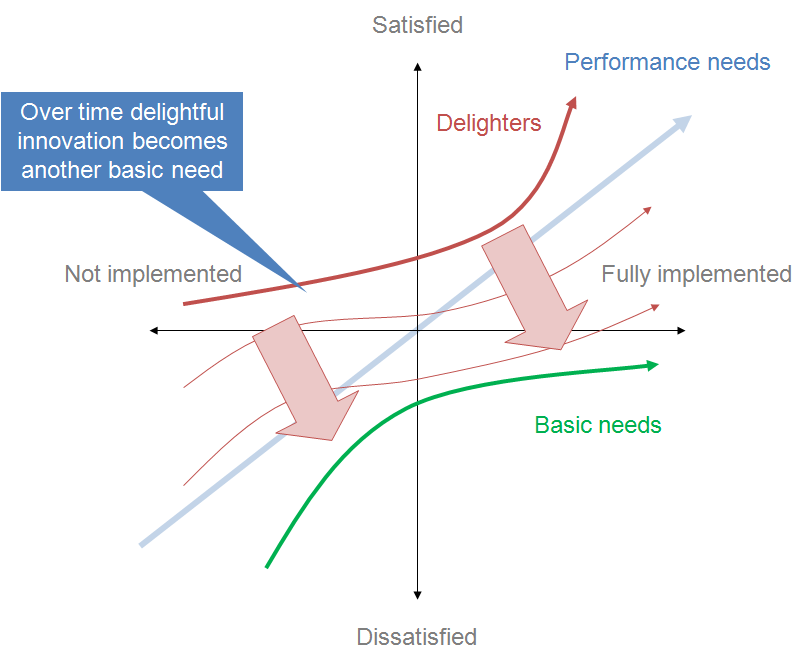
Figure. Kano Model of Customer Satisfaction
Credits: By Craigwbrown - Own work, CC BY-SA 3.0, https://commons.wikimedia.org/w/index.php?curid=23262780
Kaoru Ishikawa (1915–1989)
Contributions:
- Quality Circles:
- Self-organized groups focused on problem-solving and improving organizational performance.
- Ishikawa (Fishbone) Diagram:
- Tool for root cause analysis (Material, Methods, Equipment, Management).
- Seven Tools of Quality:
- Flowchart: illustrate or specify a process
- Pareto diagrams: classify problems according to importance
- Cause and effect diagrams: analyze the causes leading to a problem
- Histograms: reveal the frequency of occurrence
- Control charts: establish process capability and detect special cause variation
- Scatter diagrams: establish correlation between events
- Check-sheets: tabulate results through routine checks of a situation
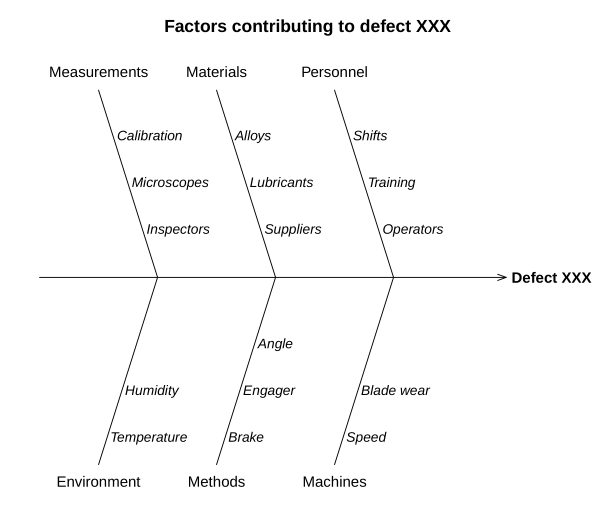 Figure. Ishikawa (Fishbone) Diagram.
Credits: By DanielPenfield - Own work, CC BY-SA 3.0, https://commons.wikimedia.org/w/index.php?curid=9401181
Watts Humphrey (1927–2010)
Contributions:
- Software Quality Focus:
- Addressing software defects to improve usability and reliability.
- Eight Steps for Quality Software:
- Establish quality policies and goals.
- Train and support developers.
- Maintain requirements quality management.
- Apply statistical control to software processes.
- Review all product artifacts.
- Analyze and correct defects.
- Manage configuration and change control.
- Continuously improve processes.
- Major Frameworks:
- Capability Maturity Model (CMM)
- Team Software Process (TSP)
- Personal Software Process (PSP)
References
- N. Kano, N. Seraku, F. Takahashi, and S. Tsuji, “Attractive quality and must-be quality,” 1984.
Disclaimer: AI is used for text polishing and explaining. Authors have verified all facts and claims. In case of an error, feel free to file an issue.